

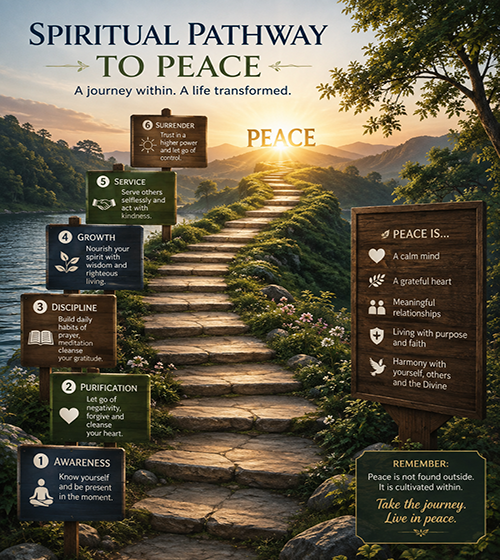
In a world filled with uncertainty, pressure, conflict, disappointment, and constant demands, peace has become one of the greatest treasures of the human heart. Many people search for peace in financial success, relationships, career advancement, possessions, recognition, or a change of circumstances. Yet, even when these things are achieved, the heart may still remain restless.
True peace begins from within.
The spiritual pathway to peace is not necessarily a journey toward a life without problems. Rather, it is a journey toward developing an inner stability that remains anchored even when life becomes difficult. It is learning to trust God, surrender what we cannot control, cultivate a quiet heart, forgive others, and live according to values greater than our immediate circumstances.
1. Peace Begins With God
At the heart of spiritual peace is a relationship with God.
Human beings often try to control everything around them: the future, other people’s opinions, circumstances, finances, relationships, and outcomes. But there are many things we simply cannot control. The struggle to control the uncontrollable can become a major source of anxiety and inner unrest.
Spirituality teaches us to recognize our limitations and place our trust in God.
When we surrender our fears, uncertainties, and expectations to God, we begin to experience a different kind of peace—not because every problem has disappeared, but because we no longer believe that we must carry everything alone.
Faith gives the heart an anchor.
2. The Power of Prayer and Meditation
A restless mind needs moments of stillness.
Prayer provides an opportunity to communicate with God, express our fears, seek wisdom, give thanks, and release our burdens. Meditation and quiet reflection, when practiced within one’s spiritual tradition, can also help the mind become calmer and more attentive to what truly matters.
Sometimes we are so surrounded by noise that we cannot hear the voice of wisdom within us.
Creating time for silence allows us to step away from the constant demands of life and reconnect with God, our values, and our inner being.
Peace often grows in the quiet places.
3. Learning to Surrender
One of the most difficult spiritual lessons is learning to let go.
We may hold tightly to past disappointments, betrayals, mistakes, fears, ambitions, or expectations. We replay painful experiences in our minds and imagine different outcomes. But the past cannot be changed by repeatedly reliving it.
Surrender does not mean giving up on life. It means accepting what cannot be changed while taking responsibility for what can.
We can change our attitude.
We can change our choices.
We can seek forgiveness.
We can begin again.
We can trust God with what lies beyond our control.
The moment we stop fighting battles that cannot be won, we create room for peace.
4. Forgiveness: Freedom From the Burden of Resentment
It is difficult to experience deep peace while carrying bitterness in the heart.
People will disappoint us. Some will hurt us intentionally or unintentionally. Relationships may end, trust may be broken, and unfair things may happen.
Forgiveness does not mean pretending that wrongdoing never happened. It does not mean refusing to establish healthy boundaries or allowing someone to continue harming us.
Forgiveness means refusing to allow another person’s wrongdoing to permanently control the condition of our heart.
Sometimes forgiveness is not something we accomplish in one moment. It is a process—a decision we may need to make repeatedly until the pain gradually loses its power over us.
A peaceful heart is not necessarily a heart that has never been wounded. It can be a heart that has learned how to heal.
5. Gratitude Changes the Heart
Peace becomes easier when we learn to recognize what we already have.
Human beings naturally focus on what is missing. We compare our lives with those of others and measure ourselves against standards that constantly change.
Gratitude interrupts this cycle.
Taking time each day to appreciate life, health, family, friendships, opportunities, nature, meaningful work, or simply the gift of another day can transform our perspective.
Gratitude does not deny our problems. Instead, it reminds us that our problems are not the entirety of our lives.
A grateful heart discovers blessings even in ordinary moments.
6. Living With Purpose
A life without direction can produce inner confusion.
Spiritual peace grows when we understand why we are here and what kind of person we want to become.
Purpose does not necessarily mean accomplishing something famous or extraordinary. It can be found in serving others, raising a family, building something meaningful, helping people, developing one’s abilities, contributing to society, or simply living with integrity.
When our actions are aligned with our deepest values, there is less conflict between who we are and how we live.
Purpose gives direction to the soul.
7. Choosing Love Over Fear
Fear can make the heart restless.
Fear of failure. Fear of rejection. Fear of tomorrow. Fear of losing what we have. Fear of what people will say.
Spiritual maturity teaches us not to allow fear to become the master of our decisions.
Love, compassion, kindness, patience, and faith can provide a stronger foundation.
This does not mean that fear will completely disappear. Courage is not the absence of fear; it is the decision to move forward despite fear.
A peaceful person learns to respond to life from a place of faith rather than allowing fear to dictate every decision.
8. Peace Requires Discipline
Peace is not only a feeling. It is also a practice.
We cannot constantly feed our minds with anger, negativity, comparison, gossip, resentment, and fear and expect to maintain a peaceful heart.
What we watch, read, listen to, think about, and repeatedly discuss influences our inner life.
Therefore, spiritual peace requires discipline.
Spend time in prayer.
Read things that nourish your mind.
Choose your relationships wisely.
Practice gratitude.
Avoid unnecessary conflict.
Learn to pause before responding in anger.
Spend time in nature and silence.
Serve others.
Give yourself permission to rest.
Small spiritual habits, consistently practiced, can gradually transform the condition of the heart.
9. Peace Does Not Mean the Absence of Problems
Perhaps one of the greatest misunderstandings about peace is the belief that a peaceful life must be a problem-free life.
That is rarely possible.
There will be difficult seasons. There will be unanswered questions, unexpected disappointments, financial pressures, relationship challenges, losses, and uncertain tomorrows.
The goal is not to create a life where storms never come.
The goal is to develop an inner foundation strong enough to withstand the storms.
A tree does not become strong because it never experiences wind. Its strength develops because its roots grow deep.
In the same way, spiritual depth gives the human heart roots.
10. Becoming a Person Who Carries Peace
Eventually, the spiritual journey moves beyond finding peace for ourselves. We begin to carry peace into the lives of others.
A peaceful person can calm rather than inflame a difficult situation.
They can listen without immediately judging.
They can disagree without becoming hateful.
They can exercise authority without cruelty.
They can correct others without humiliating them.
They can forgive without becoming weak.
They can stand for truth without losing compassion.
This is perhaps one of the highest expressions of spiritual maturity: becoming a source of peace in a world that often encourages conflict.
The Journey Is Personal
The pathway to peace looks different for every person. For some, it may involve returning to a deeper relationship with God. For others, it may mean healing from the past, forgiving someone, changing unhealthy habits, finding purpose, or learning to trust again.
But the destination is similar: a heart that is no longer completely controlled by circumstances.
Peace is not found by having everything we want.
Sometimes peace comes from realizing that we already have enough to be grateful for.
Peace is not found by controlling everyone around us.
Sometimes peace comes from accepting that other people have their own choices and responsibilities.
Peace is not found by knowing everything about tomorrow.
Sometimes peace comes from trusting the One who holds tomorrow.
Conclusion: Walk the Pathway
The spiritual pathway to peace is a journey of faith, surrender, gratitude, forgiveness, purpose, discipline, and love.
It is a journey inward and upward—a journey that teaches us to become less controlled by fear and circumstances and more anchored in God, truth, and purpose.
There may still be storms along the way. There may still be difficult days. But when the roots of the soul grow deep, the storms no longer have the same power to destroy us.
Perhaps the greatest peace comes when we can honestly say:
“I may not understand everything that is happening, but I choose to trust God. I will do what I can, release what I cannot control, forgive where I can, love where I can, and continue walking forward in faith.”
That is the spiritual pathway to peace—not a promise of a life without storms, but the discovery of an inner strength that enables us to walk through the storms without losing ourselves.
Peace begins within. It grows through faith. And it becomes powerful when we carry it into the world.

